|
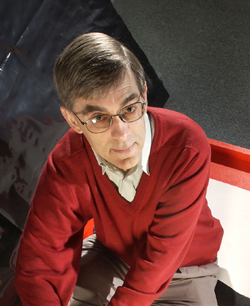
A/Prof R. Andrew Russell
|

|
Room G05 in Building 36
Department of Electrical and Computer Systems
Engineering
MONASH UNIVERSITY, AUSTRALIA
Phone:
+61 3 9905 3462
Fax: +61 3 9905 3454
Email: andy.russell@eng.monash.edu.au
|
CURRENT RESEARCH PROJECTS
This is an important sensing modality for robotic
systems, especially those involved in the grasping,
recognition and precise manipulation of objects. Tactile
sensing is not as well developed as computer vision, in
part, because of the lack of suitable sensors. I have
designed a number of highly compliant tactile sensors using
the following principles:
* Nephelometric,|
* Fluid resistance (electrical resistance), and
* Strain sensitive rubber.
Giving a tactile sensor a compliant surface enlarges the
area of contact and thus increases the information that can
be gathered from non-planer surfaces. I have also developed
tactile sensors to determine the thermal properties of
touched objects and whisker proximity sensors.
The processing of tactile sensory data and sensory
control of robotic mechanisms are other current research
topics. Sensory manipulation and object recognition
experiments are performed using the Monash Dextrous Gripper
shown below. The gripper has two 6-degree-of-freedom fingers
which are each actuated by a Stewart platform mechanism. A
6-axis force/torque sensor detects forces acting on the
work-surface and load cells in the root of each finger
detect gripping forces. The fingers also incorporate tactile
sensor arrays.
The Monash Dextrous Gripper
Tactile output devices -
Shape and force displays provide the natural complement
to tactile sensors and allow tactile information (either
real or synthetic) to be displayed. The following picture
shows an 8 by 8 array shape display. Each of the 64 rods can
be set to a height within a 5 cm range.
A prototype tactile shape display
Robot chemical sensing (see publications)
-
Quite a number of animals and insects mark their
environment with traces of chemicals. Territorial animals
deposit pheromone markings to indicate the boundaries of
their territory and to warn off competitors. Foraging ants
lay trails for worker ants to follow. Having deposited an
odour mark the stored information that it represents is
available to be read at a later time by the creature that
made the marking or by others of the same species. These
markings can be used as an aid to navigation or to help
coordinate the actions of a group of creatures. To perform
useful tasks in an unconstrained environment mobile robots
have to solve similar navigational and organisational
problems to those that challenge insects and other simple
creatures. I have called any method of storing information
in the environment in a form that dissipates over time a
short-lived navigational marker. The following picture shows
a miniature robot equipped to detect odour marking on the
ground.
Miniature robot equipped to follow chemical trail
trails on the ground
Many of the potential applications for chemical sensing
robots involve locating the source of a chemical plume
released into the air. With this kind of capability a mobile
robot could perform some of the tasks that we currently
assign to sniffer dogs including the detection of::
o plant matter, drugs and other materials important to
the customs service,
o truffles,
o victims of avalanches and earthquakes,
o escaped prisoners,
o chemical leaks, and
o mines and unexploded bombs.
In most cases vast improvements will be required in
chemical sensing technologies before robots can perform
these tasks. However, even without improved sensors it is
still possible to make progess in areas such as robot design
and control algorithms.
A robot eqipped with two conducive polymer chemical
sensors and a wind vane
locates the source of a plume of
ammonia
Robot learning (see
publications)
Robot learning is a very appealing area of research that
has a number of potential benefits. A robot with the ability
to learn would require less application-specific programming
to customise it for performing a particular operation. If
the environment changed then a learning robot may also be
able to adapt appropriately without external guidance.
For me this is a new area of research and so there are no
publications as yet. The current project focuses on the
transition between an organism whose genetically evolved
competence is purely inherited and one with the added
ability to learn from its environment. The framework of the
project draws on Rolf Pfeifer's ideas about building
complete autonomous systems that he calls "Fungus Eaters".
For this project a self-contained environment EDEN has been
constructed to act as an ecological niche for a mobile robot
(ADAM Robot). It is anticipated that the robot will be able
to improve its performance by learning from its interactions
with this environment. See below for a QickTime video
clip.
ADAM Robot feeds from a 'flower' in
EDEN
Other topics (see publications)
In order to build the robotic platforms necessary to try
out new robotic sensors I also maintain an interest in
robotic mechanisms and novel robotic actuators such as
shape-memory alloy, electrorheological fluid clutches,
magnetic fluids, etc.
Some Media
Coverage
Chemical sensing
http://www.theage.com.au/articles/2003/09/10/1062902115129.html?from=storyrhs
http://www.wired.com/wired/archive/12.07/race_pr.html
http://www.abc.net.au/ra/innovations/stories/s990572.htm
http://www.guardian.co.uk/life/feature/story/0,13026,1358531,00.html
Robot Learning
http://radio.weblogs.com/0105910/2003/08/20.html
http://www-pso.adm.monash.edu.au/news/Story.asp?ID=1075&SortType=7
Video Clips
The following video clips show some recent
experiments.
LEGO robot hockey preliminary 2002
(4.9MB)
ADAM Robot learns to avoid bumping
into a wall (1.4MB)
ADAM Robot in EDEN (a longer version
of the previous clip) 2.8MB)
Robot following a chemical
trail (1,4MB)
Robot locating the source of a
chemical plume (1.1MB)
Same as the previous clip
(better quality for people prepared to wait longer -
3.1MB)
A tennis ball collecting
robot (2.3MB)
The tennis ball collecting robot was built by a final
year thesis project student based on a robot seen in the
labs of Prof. Masayuki Inaba at the University of Tokyo.
RECENT PUBLICATIONS
Tactile Sensing
1. Hellard, G., and Russell, R.A., 'A tactile sensor
array that also grasps objects', Proc. 2006 Australasian
Conference on Robotics and Automation, Aukland, pp.1-6,
2006.
2. Russell, R.A. and Wijaya, J.A., 'Object location and
recognition using whisker sensors', Australian Conference on
Robotics and Automation, CD-ROM Proceedings ISBN
0-9587583-5-2, 2003.
3. Hellard, G., and Russell, R.A., 'A robust sensitive
and economical tactile sensor for a robot manipulator',
Proc. 2002 Australasian Conference on Robotics and
Automation, Aukland, 27-29 November, 2002, pp.100-104.
4. Russell, R.A., 'Object recognition by a 'smart'
tactile sensor', Proceedings of the Australian Conference on
Robotics and Automation, Melbourne, Aug 30- Sept 1, 2000,
pp. 93-98.
5. Russell, R.A., 'A nephelometric
tactile sensor', in Advanced Topics in Artificial
Intelligence: Proceedings of 10th Austrailan Joint
Conference on AI, Abdul Sattar (ed.), Springer, 1997,
pp. 466-474.
6. Russell, R.A. 'Sliding to improve
the agility of robotic grippers', Proceedings of the 1995
National Conference of the Australian Robot Association,
Melbourne, 5-7 July, 1995, pp.138-146.
Robot chemical sensing
1. Kowadlo, G., and Russell, R.A., 'Using naive physics
for odor localization in a cluttered indoor environment',
Autonomous Robots, Vol. 20, No. 3, pp. 215-230, 2006.
2. Kowadlo, G., Rawlinson, D. J., Russell, R. A., Jarvis,
R. A., 'Bi-modal search using complementary sensing
(olfaction/vision) for odour source localisation',
Proceedings of the International Conference of Robotics and
Automation (ICRA) 2006, 15-19 May IEEE, Orlando, Florida,
USA, pp. 1-6., 2006
3. Purnamdjaja, A. H., Russell, R. A., 'Robotic
pheromones: using temperature modulation in tin oxide gas
sensors to differentiate swarm's behaviour', 9th
International Conference on Control, Automation, Robotics
and Vision 5-8 December, IEEE, Singapore, pp. 1136-1141,
2006.
4. Russell, R. A., 'Taste and search in a robotics
context', Preceedings of the 2006 Australasian Conference on
Robotics & Automation, 6-8 December, ARAA, Auckland NZ,
pp. 1-6, 2006
5. Kowadlo, G., Russell, R. A., 'Advanced airflow
modeling using naive physics for odour localisation', Proc
of Australasian Conference on Robotics and Automation, 5-7
December, Australian Robotics and Automation Assoc, Sydney
Australia, pp. 1-10, 2005
6. Purnamadjaja, A. H., Russell, R. A.,'Congregation
behaviour in a robot swarm using pheromone communication',
Proc of the Australasian Conference on Robotics and
Automation, 5-7 December, Australian Robotics and Automaton
Association, Sydney Australia, pp. 1-7, 2005.
6. Russell, R. A., 'A ground-penetrating robot for
underground chemical source location', Intelligent Robots
and Systems, IEEE/RSJ International Conference on, 2-6
August, IEEE, NJ USA, pp. 1879-1884, 2005.
17. Russell, R.A., 'Robotic location of underground
chemical sources', Robotica, Vol.22, Issue 1, pp.
109-115, 2004.
8. Russell, R.A., Bab-Hadiashar, A., Shepherd, R.L. and
Wallace, G.G., 'A comparison of reactive robot chemotaxis
algorithms', Robotics and Autonomous Systems, Vol.
45, Issue 2, pp. 83-97, 2003.
9. Kowadlow, G. and Russell, R.A., 'Naive physics for
effective odour localisation', Australian Conference on
Robotics and Automation, CD-ROM Proceedings ISBN
0-9587583-5-2, 2003.
10. Russell, R.A. and Purnamadjaja, A.H., "Odour and
airflow: complementary senses for a humanoid robot",
Proceedings of the IEEE International Conference on
Robotics and Automation, Washington DC, May 2002,
pp.1842-1847.
11. Russell, R.A., 'Tracking chemical plumes in
constrained environments', Robotica, Vol. 19, Issue
4, July 2001, pp. 451-458.
12. Russell, R.A., 'Survey of robotic
applications for odor-sensing technology', International
Journal of Robotics Research, Vol. 20, No.2, February
2001, pp. 144-162.
713 Purnamadjaja, A.H., and Russell,
R.A., 'A sense of smell for a humanoid robot',
Proceedings of the International Conference on Artificial
Intelligence in Science and Technology, Hobart,
Tasmania, 17-20 December, 2000, pp. 312-316.
14. Russell, R.A. and Kennedy, S., 'A
novel airflow sensor for miniature mobile robots',
Mechatronics, Elsevier Science, Vol. 10, No. 8, 2000,
pp.935-942.
15. Russell, R.A., Kleeman, L., and
Kennedy, S., 'Using volatile chemicals to help locate
targets in complex environments', Proceedings of the
Australian Conference on Robotics and Automation,
Melbourne, Aug 30- Sept 1, 2000, pp. 87-91.
16. Russell, R.A., 'The world of odor:
a relatively unexplored sensory dimension for robots',
Proceedings of the 1999 International Symposium on
Robotics Research, Salt Lake City, Utah, pp.
74-79.
17. Russell, R.A., 'Ant trails
&endash; an example for robots to follow?' Proceedings
IEEE International Conference on Robotics and Automation,
Detroit, Michigan, May 1999, pp. 2698-2703.
18. Russell, R.A. 'An odour sensing
robot draws inspiration from the insect
world',Proceedings of the 2nd International Conference on
Bioelectromagnetism, Melbourne, 15-18 February, 1998,
pp. 49-50.
19. Russell, R.A., Thiel, D. and
Mackay-Sim, A., 'Recruiting swarm robots using coded odour
trails', Proceeding of the International Conference on
Field & service Robotics, Canberra, 8-10 December
1997, pp. 472-476.
20. Russell, R.A. 'Heat: A short lived
navigational marker', Video Proceedings of the IEEE
International Conference on Robotics and Automation,
1997, Albuquerque.
21. Russell, R.A. , 'Heat trails as
short-lived navigational markers for mobile
robots',Proceedings of the 1997 IEEE International
Conference on Robotics and Automation, Albuquerque, pp.
3534-3539.
22. Russell, R.A., 'Laying and sensing
odor markings as a strategy for assisting mobile robot
navigation tasks', IEEE Robotics and Automation
Magazine, September 1995, pp. 3-9.
23. Russell, R.A., 'A practical
demonstration of the application of olfactory sensing to
robot navigation', Proceedings of the IARP Workshop
Robotics for the Service Industries, Sydney, 18-19th May,
1995, pp. 35-43.
24. Russell, R.A., Thiel, D., Deveza,
R., and Mackay-Sim, A. 'A robotic system to locate hazardous
chemical leaks', Proceedings of the 1995 IEEE
International Conference on Robotics and Automation,
Nagoya, .pp. 556-561.
Robot Learning
1. Russell, R.A. 'Mobile robot learning by
self-observation', Autonomous Robots, Kluwer Academic
Publishers, Vol. 16, Issue 1, pp. 81-93, 2004.
Other Topics
1. Stewart, R. L., Russell, R. A., 'A distributed
feedback mechanism to regulate wall construction by a robot
swarm', Adaptive Behavior, vol 14, ed 1, Sage Science Press,
UK, pp. 21-51, 2006.
2. Silvola, A., Russell, R. A., 'Robot Communication via
substrate vibrations', Proc of the Australasian Conference
on Robotics and Automation 5-7 December, Australian Robotics
and Automation Assoc, Sydney Australia, pp. 1-6, 2005
3. Stewart, R. L., Russell, R. A., 'A generalized
technique for building 2D structures with robot swarms',
Recent Advances In Artificial Life: Advances In Natural
Computation, 5-8 December, World Scientific, Singapore, pp.
265-277, 2005
4. Zhang, A. M., Russell, R. A., 'Dominant orientation
tracking for path following', Intelligent Robots and
Systems, IEEE/RSJ International Conference on, 2-6 August,
IEEE, NJ USA, pp. 1726-1730., 2005
5. Stewart, R.L., and Russell, R.A., 'Emergent structures
built by a minimalist autonomous robot using a
swarm-inspired template mechanism', Proceedings of the
Australian Conference on Artificial Life, Canberra,
Australia, pp. 216-230, 2003.
6. Price, A., Jarvis, R.A., Kleeman,
L., and Russell, R.A., 'A lightweight plastic humanoid',
Proceedings of the IEEE/RSJ International Conference on
Intelligent Robots and Systems, Takamasu, Japan, Vol. 3,
2000, pp. 1571-1576.
7. Wallander, A., Russell, R.A., and
Hyyppa, K., 'A robot scorpion using ground vibrations for
navigation', Proceedings of the Australian Conference on
Robotics and Automation, Melbourne, Aug 30- Sept 1, 2000,
pp. 75-79.
8. Chetty, G. and Russell, R.A.
'Electric field based sensing for underwater vehicle
guidance', Proceedings of the 2nd International
Conference on Bioelectromagnetism, Melbourne, 15-18
February, 1998, pp. 139-140.
9. Chetty, G. and Russell, R.A.,
'Electric field based obstacle avoidance', Proceedings of
the International Conference on Field & service
Robotics, Canberra, 8-10 December 1997, pp.
378-382.
10. Liu, C., and Russell, R.A., 'A
gopher robot', Proceeding of the International Conference
on Field & service Robotics, Canberra, 8-10 December
1997, pp. 313-318.
11. Russell, R.A., 'Creating adroit
mechanisms by using large numbers of simple homogeneous
structures', in Advanced Topics in Artificial
Intelligence: Proceedings of 10th Austrailan Joint
Conference on AI, Abdul Sattar (ed.), Springer, 1997,
pp. 456-465.
12. Russell, R.A. 'Temperature
feedback improves the performance of shape memory alloy
actuators', Proceedings of the 1995 National Conference
of the Australian Robot Association, Melbourne, 5-7
July, 1995, pp.354-361.
13. Russell, R.A. and Gorbet, R.B.,
'Improving the response of SMA actuators',Proceedings of
the 1995 IEEE International Conference on Robotics and
Automation, Nagoya, pp. 2299-2304.
14. Gorbet, R.B. and Russell, R.A., 'A
novel differential SMA actuator for position control',
Robotica, Vol.13, Cambridge University Press, 1995,
pp.423-430..
Books
1. Russell, R.A. Robot tactile
Sensing, Prentice Hall, Australia, ISBN 0 13 781592 1,
184pp, 1990.
2. Russell, R.A. Odour Sensing for
Mobile Robots, World Scientific, ISBN 981023791X, 217pp.
1999.
|